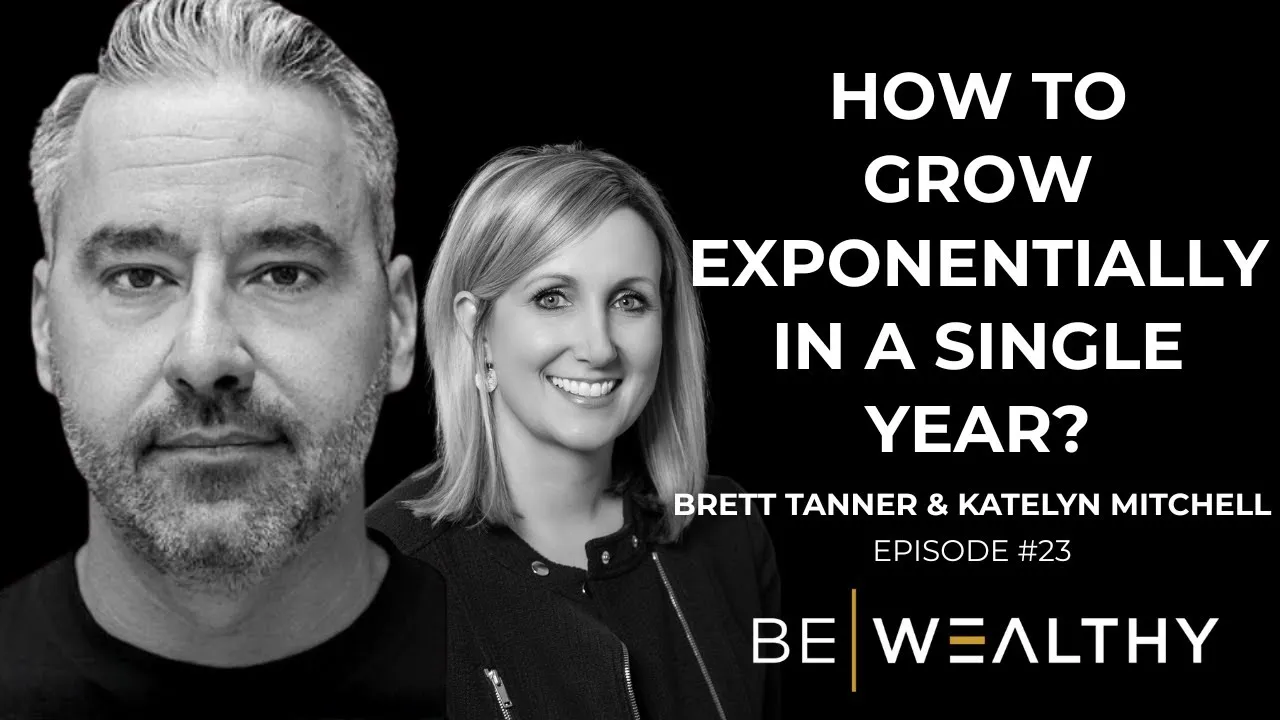
Brett Tanner and Katelyn Mitchell run through the 10 questions Brett asks his private coaching clients every year, from whether you're playing for an internal or external scorecard to whether your business actually runs without you. Katelyn shares how she carried a stranger's offhand comment that she was "sloppy" for eight years because she was playing for everyone else's approval instead of her own.
 Brett TannerHost, founder of Be Wealthy
 Katelyn MitchellCo-host, runs operations for Brett
Brett has every coaching client build a 30-year plan that ends at a minimum of $50 million, then asks what that money actually produces and what they'd do with it. He says without that target, you have no way to tell weekly or monthly whether you're on track or off track.
Jump to 6:18Brett got this from Kent Clothier, who pushed back when Brett called wholesaling a bad business. The real test is whether a belief holds up in the data: saying marketing feels like it's working is your truth, saying cost per deal is down 21.46% is the truth, because the math can be checked.
Jump to 13:33Warren Buffett's version: would you rather be the best in the world at something with no one knowing, or the worst with everyone thinking you're the best? Katelyn says she carried a stranger's offhand comment that she was "sloppy" for eight years because she was playing entirely for other people's opinion of her.
Jump to 19:55If your goal is $200 an hour but you're driving to make a bank deposit, Brett says you're doing work beneath your rate and should pay someone $20 to do it and pocket the other $180. He says this is the single biggest mistake he sees in his coaching clients.
Jump to 37:47Borrowed from Dan Sullivan's book, the question is: if we're sitting here 3 years from today looking back, what has to happen in your life, both personally and professionally, for you to be happy with your progress? Brett has used it on his own wife, on job candidates, and on anyone considering his mastermind.
Jump to 47:13Brett's test: if the business depends on you to function, you own a job, no matter how much money it makes. If it can keep running while you're gone, that's a business. He says there's no judgment in having a day job, as long as you're honest about which one it is.
Jump to 50:17Brett says you need someone ahead of you, a coach who's already done the thing, someone beside you, a peer walking the same road, and someone behind you that you're mentoring. At 25, he mailed a check to a stranger he wanted as a mentor, who never cashed it, and says that one relationship changed his life.
Jump to 54:26It's when you play for the applause of others, what happens when they don't clap?Brett Tanner · at 26:12
Tap any chapter and the video starts right there.
“All you are is what you want to become and who you are as a person.”
Brett Tanner at 28:17These 10 questions are the same diagnostic Brett runs with coaching clients before building out the kind of plan the tool walks you through.
Brett Tanner starts with what you actually want out of your life and why, built around a 30-year plan that ends at a minimum of $50 million. He says without a clear target, there's no way to measure weekly or monthly whether you're on track.
Brett and Katelyn borrow this from Warren Buffett: an internal scorecard is measuring yourself by what matters to you and your own household, while an external scorecard is chasing the approval of people outside it. Katelyn says she spent years playing for an external scorecard, chasing being seen as the hardest worker instead of being fulfilled.
The question is: if you were looking back 3 years from today, what would have to happen in your life, both personally and professionally, for you to be happy with your progress? Brett says it works because it makes you write the history first, then reverse-engineer the plan to get there.
Brett's test is the dollar per hour question: if your goal is to earn $200 an hour but you're doing a task worth $20, like making a bank deposit, you should pay someone else to do it. He calls this the single biggest mistake he sees among his coaching clients.
Brett Tanner's line is that if the business depends on you to keep running, you own a job, no matter how profitable it is. If it can keep running without you there, that's a business. He says there's no judgment in that. You can run a day job and build a business at the same time, as long as you're honest about which one you have.
0:00A better question is not how do I sell 80, it's how do I sell 400.
The more amps you get, the more you bring it up to the next level. Is the more insecure you actually are because you don't know the situation.
It's when you play for the applause of others, what happens when they don't clap? Are you building a business or do you own a job? And the older I get, the more I realize a lot of stuff's just made up. Like so much in life, I joke with you like all prices are just made up. Welcome back to the VW Wealthy podcast. I'm Brett Tanner. I am joined by the one and only Katelyn Mitchell. Katelyn, we're talk about champions for a minute and because your husband because your husband and I are champions and uh I don't use that word loosely like to describe someone that thinks
because you know me in life, not just because you both know me. We just played in the member Gasm of myite club and we're champions. Did we win the entire tournament? No. Did Were we close? Yes. But did we win our flight?
1:02Yes. And in that context, Katelyn, champion. Champion.
Well, I am very proud of both of you. Um, I understand you tore it up and I also understand you guys had an incredible time. So, which was the most important part. But I will tell you the FOMO that existed for me, Mr. Tanner, two of my favorite humans in the entire world, spending four days doing some of my favorite activities. I couldn't have been more excited for both of you. But also, man, that FOMO, good news. We'll head out to Apple Mountain and the three of us will tear it up.
We will. We're going to be back there very soon. Very, very soon. Less than two months.
Less than two months. But when I was out there becoming a champion, which is we're not here to talk about golf and champions, it's another episode. But uh I was asking Russ and we talked a lot. We have a lot of we had a lot of questions. And I firmly believe that the quality of your life will be the quality of the questions that you ask. M.
And so, uh, and I know that's like a
2:07bumper sticker, Katelyn, but I really think that
it's like half bumper sticker, half fortune cookie.
Uh, I will tell you that the questions you ask a lot of times determine the work you do in the past you travel. And I learned that if I wasn't getting where I wanted in my own personal life, I was I asking the right question. And you you see me do this a lot in our businesses. And I we have any problem we're like wait let's redefine the problem and make sure we're solving the right problem like what is clearly defined the problem right so we've got like
the phrase you say to me a lot Brett is baller I don't think we're asking the right questions
you you say that to me maybe three times a week
baller I don't think we're asking the right questions
and so you can because you can have a symptom of a problem right but Like we're not asking, you know, wait, what is the actual problem we're solving, right? It might be the tractor's out on the golf club. Okay, got that. Buy a new tractor. Not hard to figure out, but
3:11what are we actually doing?
The tractor, well, it maintains the rough or it does this other thing. Okay, well, what is why can't the rough just not be cut, right? Like, we've got to start. I mean, and now that might lead you nowhere and it might also lead you the most incredible breakthrough. And so what today's about is the top 10 questions I ask my private coaching clients. And whether you're going to coach or not is irrelevant. Everyone should have a coach and you should go watch our last episode that we filmed about the three relationships you need in life. I won't spoil them for you, but one of them is a coach. Um the other two you got to go listen to that last episode. But today I want to talk about the 10 questions that I ask my coaching clients. There are 10 questions all of our listeners and viewers should be asking themselves. Some are my questions, Katelyn, that I've created and I will tell you and we will indicate that where and then I will not plagiarize. Some came from other people and I will give that person credit as any true author or speaker does. Katelyn, a lot of people talk, not everyone speaks. There's a huge
4:13difference there that I want to get into with you um that you're keenly aware of. Uh but there's 10 questions everybody should be asking. There's so many inside bits we do on this podcast that she
I'm actually going to tell them where this comes from. Yeah, I'm gonna actually tell them where this comes from. So, years ago when we were hosting events, um Brett would it's it's kind of a pain in the butt if you haven't done it before to put your microphone on and it's got to go like, you know, if you're at a speaking event, it's got to go like down the back of your shirt and it's a it's a mess. But we would be at speaking events and we would be leaving to go off campus for lunch to meet to go over some things. And Brett would continue to wear his microphone out to lunch. In proper Brett fashion, at the time he only went to lunch to two places. So we either went to Charleston's, which was his standard place. He had a standard booth, ordered a standard meal. No one asked him any questions. They just came and dropped off the food. Or we would go to Houston's. this instance, we were going to Houston's a lot up in North Scottsdale because the venue was right next to it. We would
5:15go to Houston's, he would order his lunch wearing his microphone and then he would come.
It's not like it's one of these where it's like it's like chambered here. Yeah. It's like, you know,
it's it's 100% it's like a a McDonald's drive-thru microphone of the future, though. Like, it's the the one that it's right on the It's touches the lip. And he would proceed. The poor waitress all she wants to do the server she just wants to give him his salad and tell him and his iced tea she wants her 20% and she wants out of there but instead he would say some people speak
everybody talks everybody talks some people are speakers and I'll let you determine what the difference is
so you say hi Sarah thank you so much for welcoming us here we're excited to be at Houston's I already know what I would like and I believe the rest of the table does but before we jump into that. And then he would run this bit with her and the poor gal just wants to move on. So now to this day to both he does this to his wife. He says it to his wife all the time and he says it to me constantly
6:18this bit. So now Brett everybody knows and you can run around the world running this bit to absolutely everyone and they're going to love it. It's going to drive them wild.
And I'm going to tell you few mountains or higher than being a public speaker. I mean it is the pinnacle. I say that jokingly because there is no job that is more you will be everyone demands everything from you all the time. It is the hardest job on earth and I would never want to do it. Uh and it's so that's why I make the joke is guys are you a speaker? Excuse me. Everybody talks and everybody speaks. So Katelyn being a talker and speaker you got to have great questions. The number one question, the number one question we should be asking ourselves where and it's the frame of two things. I start all my coaching clients this way. Number one, what what do you actually want out of your life? So, where do you want to go is that question and where are you at right now? Right? What do you actually want out of your life and why? It's a huge question,
7:21right? And this is numbersbased, not it starts with numbers leads to a story.
So when we um we've got this six-hour workshop anywhere from six to I mean we could toggle it in there, but we've you and I have taught it on the road for five years and we make everyone that comes to this workshop, they've got to go and do a $50 million plan. Meaning in 30 years from now, you cannot walk in the room. We give you the format, the video, and the whole way to do it in the framework. And we could drop that in the show notes. Uh we actually will. We'll have Cole drop that video plan um and everything on the 30-year plan into the show notes. And so they go do this exercise and you you have to go into the cells as is an Excel. You got to have $50 million at a minimum on the bottom far right hand side. And it doesn't matter where you are today. Then the first row is where you are today. And you have to build a plan like what assets will you buy and how many and what rates of return and all this stuff that we give you the framework to do it to be worth a minimum of 50 million. Now, you could make it 200 million. Like some of our coaching clients, Kobe's is
8:22250 million. He's ahead of goal, which is awesome. Shout out to my boy Kobe. Um, so like you could build anything you want, but you've got to have it. Now, the part is all right, we we get it's 50 million. So, some people Katelyn come in at 62 and it's 75 or whatever. Part two is what does that do for you, right? If you have a $50 million plan and it's spinning out 10% per year or let's say 40 million of it is investable capital and that's doing 10% per year. You got four million bucks a year coming in passively. You could spend every year. What are you doing? What does it look like? Why? Why? Do you really want the yacht? Maybe, right? But maybe like we're just going to go on the yacht trip, right? There's some things I want to rent, Kate. There's some things I got to own, right? It depends on how often I'm going to be there. But so figuring all that out, it's why why some people say, "Well, Brett, someone hires you as a coach. Why in the hell are you doing here? you haven't talked about their business or anything. Well, if we don't know where we're going, well, they don't need they can go down any they can go down any road they want.
9:24And so, we got to get clear on what do you want and why, right? Backed into today. And the ultimate thing we're going to establish there is a way to weekly, monthly, annually to know if you're on or off track. Spoiler alert, Katelyn, everyone gets off track in their life. I know it's crazy to think about it. People that are trying to accomplish big goals got off track. Like I I know that we think Elon just went from like this to trillionaire. It's like here's nothing and then there's trillionaire. Kaboom. It looked like, you know, like a heart failure situation on a you know on a screen where it's going up and up like it's going up and down up and down. So because like it's everywhere and so we've got to have a way to measure it. And the way that you think about that, right, Katelyn? If you're running a marathon and let's pretend that all the scenery is the same, there's no mile markers and you're just running,
okay?
And there's no check-in point, right? So most marathon you're like, "Hey, I did this amount last mile, right? And so my pace, I'm off of my pace. I got to pick it up. How am I, you know, pacing towards goal or my progress? How do I feel?" Well, if I couldn't know anything, do you think it's there's a
10:26chance, Katelyn, that I think I've ran maybe further than I did? Of course, we're always like, "Oh, I'm almost done." You're like, "Well, you're not even halfway, right?" But if I don't know,
it's the same
It's the same way in our lives, right? People are going to spend their whole lives working and yet they have no idea where they actually want to end up and what it would mean to them. And so they go to work every day and they fight really hard and they're working for their family, Katelyn, are doing all of these things, but they haven't asked the question, "What do you actually want? What does it look like? Have you talked about it with your partner?" Right? The one way you do it when you get married, the way I did it is she went and did her vision board. But I know this whole thing on uh you know the Instagrams and all the places out there today. It's like vision boards are crap and I tell you vision boards change my life cuz it was in here. I put it out there and I stared at it every day. And then what happens when you stare at something every day, Katelyn, when you go to sleep at night, your subconscious mind starts conjuring up ways to bring what you said you wanted to reality. And I can tell you my first vision board, I had to I
11:27had to throw it away five years later because I accomplished it all. I didn't throw it away. I just put a new one up, right? And I've got one I'm driving at right now.
Every time every time I met with you for years when you were down at the office on baseline, your vision board was right there in that office, right behind your computer screen. But you also set far out what you were trying to accomplish. No question about that. But it's the where are you today and the bridge between those two that I think is really important. I have got reminders of what I want all around my house, right? If you go around my house now to to my to my wife's regret there. I mean, like in our bedroom, which is not the best place for this one, uh hangs a sign that says future billionaire now. It used to be in my office, but I got a different one there that symbolized something different, but like and she's like, "That's a lot." I go, "Yeah, I see it every day. It's all I think.
Wake up. Wake up every morning, open up my eyes, and I see it. I see future billionaire. I'm like, there we go.
12:30Let's go get it. Right. So, number one, first question. Okay. Where do you want to go and why and where are you at? We got to start there. Right. That and that's not just a question we're going to throw out on the first call. We're going to frame that in, build the plan, take the model, create the measurement stick, and go there. If you need help in your business right now, you've got a challenge or an opportunity that you really want to hone in and capitalize on it and make a game-changing breakthrough in your business, come out to our one-day workshop. This is something we've never done before. We're now doing them at the resorts we've bought. So, they could be at Apple Mountain, Georgia. They could be in Northern Arizona. Um, they might even be in Bise in the future. But, you get to come to a one day where there I'm not going to present slides. It's literally you and your business and you're going to leave with an action plan you can implement in your business. Go to bewealthypodcast.com and you can click on our upcoming events and see where we'll be and book to come. We have the room is limited. We have no more than 15 people in the room. Go to bewealthypodcast.com and you can book our one-day workshop coming up. Second question comes from my buddy Kent Cloier
13:33who is one of the coolest humans. I love you brother. Great dude. Um we met because I was speaking out in San Diego and he taught at the time he taught real estate investing but he taught wholesaling and I had never wholesaliled a deal back then. And I was like, I met him and I went, "Oh, you teach that disgusting part of the business that basically takes advantage of of old people. Congratulations. What a what a real honor." And I was like annoyed. And he go he literally goes hits me with this one, which was like a hit in the face. He goes, "Oh, really, Brett? Is that your truth or the truth?" I was like, "Huh? What? How many kinds of truth are there? I don't even know. What do you mean my truth or I go? It's my truth." And that's what he said. He goes, "Exactly. Because it's not the truth. Anything done bad is bad. But telling someone that you're going to buy their home for cash and you have a network of investors and you want to sell that contract, contracts are sold in all kinds of businesses. Almost every business on Earth, Katelyn, can monetize a contract. Many businesses, that's their entire like point of existence. Like there is a businesses built around
14:35this. And the whole point was like, how many times in our lives, Katelyn, is something our truth but not the truth? We're living in a way we're making decisions because it's our perception created our reality, but it's not fact.
And the older I get, the more I realize a lot of stuff's just made up. Like so much in life, I joke with you like all prices are just made up. It's all made up. You think that that you think that the restaurant on the quarter knows the profit margin on the the average little mom and pop on the on the French dip? Hell no, they don't. on the chicken parmesan. They're like, "You know what? It's 1850. Try that. Let's see if we can move it at 1850." Instead, right, the smart people are doing something different. But we've got to get to truth. And part of that, Katelyn, is being vulnerable and being willing to accept the truth. Like, where am I wrong? Like, where is my thought process? Not thinking through it. like where where do I have maybe something that was true in one set of circumstances but that would be
15:38incorrect you know if you looked at it in more than one thing and so everyone gets stuck everyone gets stuck Katelyn you know like I I'll tell you a truth that I hear a lot that doesn't work in my market you ever heard this one my favorite my favorite I love it when you teach oh you don't understand Brett you come from Phoenix that doesn't work in Witchah oh really well okay Like they can't hire assistants out here. Like the you mean the people out here don't work or like they're different, they're aliens over here or what? Like no, it's you know you how about this? You can't find deals in my market that doesn't work in my marriage. All of that is where that person is saying, right? They've created a construct of reality that isn't real.
You know, it's so funny. A second layer to this is has come up so much in the way you and I have interacted over the past you know I'll call it 10 12 years um and you you know we debate ideas constantly constantly and sometimes
16:45you'll know this your girl gets pretty passionate about her ideas and I am
really really
just I really can dig it in And you will say this phrase to me, a couple different ones, but one in particular will be like, "Baller, I don't know why you're getting so defensive about this, but I know because you're defensive about this that you actually aren't really thinking through." Like, you're so stubborn and stuck in it, that it has to be this way. This is the only thing that would work, but you haven't done any of the research, had any of the experience. It's just your belief and you're digging in. The more you dig in and act defensive, passionate about it, psychotic about it without any of the facts or data, the more amps you get, the more you bring it up to the next level is the more insecure you actually are because you don't know the situation. If you did, you could listen to another idea. By the way, it's me, Brett, your friend. I just am asking a couple questions and you're getting yourself all riled up about the fact that it will not work or that I'm wrong
17:50and that shows me you actually aren't looking at the truth. you're looking through it in your truth. And it was it took me of course in proper way it you know that isn't even true right you know I'm pushing back on that right it's just over and over u but it took me until it still creeps up but a couple years ago where I was like you know what it's weird that I do get so defensive about that and that usually is a signal that I have a hole on the back end that of knowledge education or experience that I'm so passionate
correct and I riled up and get so passionate it and you're like, "Just because you're talking louder doesn't mean you're right." Katelyn, you say that one to me. Just because you're louder doesn't mean you're right.
Well, but so we what we have to be able to do is it's completely fair. And what we have to be able to do as people is hold two competing ideas, right? Two ends of the spectrum.
Sure.
And be and be able to objectively look at both. Doesn't mean that you're saying both are right. But like, you know, anytime you're debating an idea, you go like, "Oh, let me look at it from the
18:52other side. Can I honestly take my ego aside,
go to the other and see the merits of their position? And if you can hold two ideas in balance,
you can get to the truth, which is what we're trying to get to, right? So
I think that's such an important question. Such an important question for a coach to ask. Is it your truth or is it the truth? Because we come with a preconceived notion, a preconceived paradigm. And if instead we can open our aperture to see more of what's available, all of a sudden we can make the right decisions to reach our goals. I that's my favorite one.
And one more. It's got to be like I will tell you the truth usually in almost all things and I could find a few examples that would be more qualitative, but usually Katelyn the truth has to be in the data. It's in the it's in the raw data and the numbers.
Meaning I believe that our marketing is doing better. Okay, that is definitely your truth. I believe that our marketing cost per deal is down 21.46%. That is the truth if the math's done
19:55right. One of those is emotional. I feel like sounds like this is amazing in my gut and tummy. The other one is I could go I can go to Wells Fargo and deposit these returns because it's math-based. And so we got to get to the truth. Um number three is actually my favorite. And I learned this from the one and only Warren Buffett. And the way he describes it, Katelyn, is there's two scorecards in life.
Okay? And he asks a question golf scorecard, by the way.
None of those are a golf scorecard. Uh there's two scorecards life. And the way he asked the question, he said, "Katelyn," and you don't have to answer this because it's going to be a little inappropriate. This is going to get a little on the edge for our show because we're very clean comics. He says, 'Would you rather be the best lover in the world and have no one know it, or would you rather be the worst lover in the world and have everyone think you're the best?
And another way to say it, right, is if you couldn't post it online, would you
20:58still do the thing? Would you buy the thing, do the thing? How if you couldn't tell anybody? And what he's talking about here, right, do you live for an internal scorecard? meaning what's best for Katelyn and and I'm going to say when I say internal I think it's you and the people that live inside of your house. Okay? Like are you playing for the people that you love that are going to be with you your entire life? That's your partner, your kids. Or are you playing but I and I really think it's got to be in your house so it doesn't leave the home. or are you playing for an external one which could be your parents, it could be your distant relatives, it could be your friends and associates and just the inetranets, right? What are you playing for? And I think the more that we can Katelyn remove our egos and step back and go, wait a minute, if I couldn't tell anyone about this,
would I still would I still do it? Would I still go to Aiza if I couldn't post the photos? Like it it and the way to think about this kid, the people at the
22:01beach that spend the three hours, the girls that are down there with their lips out and doing all this and it everyone should staff the photo to capture the memory with their lips out and the whole thing and you're like, you know, they're doing the pucker the whole deal and you're like, why did you come to the beach? Cuz you could have AIed the the thing back in and they're like telling everyone how great their time is. And yet I'm sitting behind him going, I know your time is shitty because you're not experiencing it. you're experiencing taking a photo and being addicted to your phone for an external scorecard that doesn't matter. And so it's
I'm gonna challenge this for a second.
Challenge.
I think
Well, NO, Not i'm challenging that. i think if you're like Well, for me, I would hear that and um I was really never like the selfie in first class kind of gal. Like I was never really that. Um, but there were certain things that I was Well, don't get me wrong, I do like some nice things. There's no question about that. However, uh, you
23:04came at me on this and held me accountable early in our relationship together and working together when you were my mentor in that capacity. And you said, and it took forever of you badgering me and holding me accountable to this question of my internal scorecard versus external. It was not a visa and the puckered lips. I don't know if anyone's seen this. I have the smallest lips, right? It just it was never that. It was my external scorecard was did someone else think I was good enough? And did someone else think I was great? Did someone think I was the hardest worker? You know, I wouldn't necessarily get to work and be the first person there for myself so that I could achieve the day. It was to prove to everyone else that I was the hardest worker or that I was the most successful at something or that I was always constantly trying to show that I could be the smartest person. That I you you couldn't outwork me. You couldn't outproduce me. You couldn't out because I wanted people to think I was great. I didn't want people to think I was rich.
24:07I didn't want people to think any I wanted people to say, "She's so great. Oh my gosh, I want to hire a Katelyn." That was literally like the greatest compliment at the time people could give me. And you said to me, "Baller, it's going to be non-fulfilling and exhausting over time because you're never playing for your own internal scorecard. If Susie Q thinks you're the greatest person in the entire world or she thinks you're an absolute idiot, will that actually change your and Russ's life?" And I was like, "Not really." He said, "So then why do you care so much? You have to figure out what works for you on your internal scorecard." and you beat me over the head with this. There was a specific person who told you that I was sloppy like a hundred years ago and I carried that thing for like eight years all the way to a live event that we had with them a couple years ago and I was like and then they were so nice and kind to me and none of that was tried and created this entire thing about the external scorecard of what this person thought of me and it ruined like
25:10numerous things for me all because I cared so much what someone else thought. So, when you hear this or read this, you or think about this question, you may be thinking, "Am I am I playing for an external scorecard? No, I don't have the Range Rover. I don't have the Lamborghini. I'm not flying private. I don't have to have the $10,000 purse." So, you won't have those issues, right? But the fact of the matter is, you may be playing for an external scorecard that's some other hole you're trying to fill. And until you figure out what your internal scorecard is of whether you can measure if you won or lost the day that has nothing to do with anyone else around you, it's only about you and the people in your home. Until you can get there, you will constantly be chasing something and be unfulfilled because those people, those those analysis of you, that that viewing of you, that lens, you have no control over it. You have no control over what other people think of you. You only have control over your actions. And that was one of the
26:12greatest gifts that you've given me.
I still struggle to keep badgering me.
Everyone needs to go back and listen. That was just so beautiful the way you I mean it it's it it's so true, right? They the problem though, I'll say it differently, Katelyn, when I heard you describing that. It's it's when you play for the applause of others, what happens when they don't clap?
Right. It's devastating.
The it's devastating. And so, and by the way, the only reason I learned this, Katelyn, because I was the guy playing for external scorecards. I will tell you, I joined Keller Williams in 2008. I went to the first family reunion. The top five people, they have a bunch of different awards for individual bottle. The biggest who sold the most, the biggest, the best competed for these five spots, right? Top five,
you know, in the com in the company. I saw there I mean 2008 I was unranked. I I have to do that. I have to get on that st. I literally obsessed, plotted, made every goal in my life was to get on that damn state. Did it in 2011. And I'm going to tell you, it was had
27:15nothing to do with what I wanted internally. It had everything to do with an external scorecard that I was going to prove to everyone that I was great. Katelyn, it would have taken you 11 seconds to find like I would tell you how great I was. I was like, "Listen, boom, did it right." Like I right because it was all external. And the greatest moment of my career was walking that stage. The worst moment in my career was what happened 30 seconds later
when I walked off stage and no one cared. Clap, right? And when that applause quit, I went I the blood, sweat, tears, and pain that I endured to get on here was completely not worth it because I was playing for everyone else's opinion. So we walked off that stage. The story was people left our company. We were went to unranked and I was like I'm going to walk one more damn time. So two years later we got back to top five in the entire company and I had the whole team walked out there in front of me and they went and got the award and it was all about them.
And that was the transition for me like where it's like guys you did this and we
28:17did it as a team and the team won the award
in 2013. In 2011 I was convinced that I did it all which I didn't right but my ego was so out of line. Um, and so I think people that you should all am I doing and it should be a daily practice. Am I doing this for an internal or external scorecard? I spend the most time on this with my kids because I got three teenagers and I use the analogy Kale that I used with with you which is all right. If everyone you know my daughter, right, I've got a sophomore. If everyone in the school thinks you're an idiot and you're terrible and awful, are they right? Did anything change though? And you as your internal, right? your everything, you know, believe your cauldron of work, your life, everyone believes you're the worst ever. Is that true? Well, no. Let's go the other way. Let's say they all believe you're the greatest human of our time. Is Is that true?
No. They're both wrong. All you are is what you want to become and who you are as a person. So, find out what you want, which is why we started with what do you
29:20actually want? But start playing for an internal scorecard. It's more fulfilling and you're not chasing uh validation from people that you don't know and who actually don't care. Right. We all think that everyone's looking at us. They're busy with their own lives and stuff, Katelyn. They got their own stuff.
No, no one cares.
And and do you agree as a coach, Katelyn? How many of our clients battle with this? The internal and external scorecard.
A ton. Here's the thing that I think is important. We started with where are you actually, right? That was question number one. Where are you today? And what do you actually want to accomplish? You and what does that mean to you? You layered that. The second question is the the lens of truth, right? Is it your truth or the truth? Okay. Then you look at the next layer. Are you playing for an internal scorecard? Meaning what we just discussed in option one. What are you trying to accomplish? Are you on track or off track for it? That's your internal scorecard. Or are you playing
30:23for an external scorecard? The reason that question is so important is if you're playing for the external scorecard, those small deviations that you're going to make over time for the external scorecard will rob you of number one, which was where you want to go. So, if you're playing for the external scorecard, you're going to make small changes over time in order to fit what they need. Maybe you're buying the thing you can't really afford. Maybe you're, you know, going to work at 6 in the morning to prove you're the hardest worker possible and not having that coffee with your spouse or you said you wanted to be a great wife or a great husband. You make these small changes when you're playing for the external scorecard that will over time, you know, you talked about the slight edge. We love that book. Over time, it will rob you of what you actually want to do. And that's why they have to be layered that way. Number one, where are you actually and where do you want to go? Number two, what's the actual lens we're working through? Your truth or the truth? The right lens, the right aperture to see everything. And then, are we doing this for us or for others? You have to be
31:26very clear on that because if it's for others, throw the west away. Nothing matters. Lose yourself,
go for it. But if it's for what you want, now we measure every decision according to it. Look, if you're out there and you're a real estate agent and you're having success, but yet you don't feel like you're successful. You're making $500,000, $700,000 a year. And you're asking yourself, "Where does the money go? I don't have the time. I've got I'm trying to be at home. I'm trying to be with my kids. I'm trying to have a big career." And you just feel like there's you're missing something. I think it's because you are. And if you come to our one-day workshop, you can see the testimonials on our website. Go to be balthyodcast.com. Come spend a day and let's show you a different way to play the real estate game that helps you hit your goals. Go to bewealthypodcast.com.
So, Katelyn goes to number four. I mean, now we got to go to number four. How do you actually win? What's your plan? Like, based on effort, how do you win as a father, as a husband, as a wife, as a leader, as an investor, as a
32:28friend?
How do you win? I don't think most people are asking that question. How do I win? You need to define winning, Katelyn, in every area of your life. It's the one thing you can control as your own effort. So, how do you how do I win as a husband? I win by honoring the rituals that I've built with my wife. I win that through date nights held. I win We did had a date night last night. I I win that through every morning, one of our rituals is we have coffee together. Now, sometimes it could be like two cups, but you it's always at least 15 minutes, right? We both wake up. Whoever is up and about first is going to get the coffee for the other. And we come back to our bedroom. We sit there. We got one of these crazy, you know, I got every sleep tool imaginable, Katelyn. So, basically, our bed turns into like a recliner.
Every apparatus, it turns like a recliner, and we sit there and I usually lay a book for my coffee, you know, holder. I lay a book there. Um, and we just talk about our day. What are you looking forward? What do you got on tap today? And it's just our connection time, right? But how do I define
33:31winning? I define that by connectivity there, right? It did I do my coffee? Did I have my date night? Was I present? Right? The best thing you could do, by the way, is just as a human being today, be present. The great, you know, Ali Nasser, you know, who we interview podcast, his quote was, "The greatest gift you can give to another person is your presence." What do you mean screen down, eyes up? Actually listening to what the person says,
not waiting to just slam your question or your thing. Hey, let me tell you about the time at one time what I did at band camp. No, it's listening to actually their story. And so define how you win. Um, by the way, we said in
one thing you skipped over quick. Yes. As a father, a husband, a leader, an investor. Those were the examples that you gave us, but you you skipped over something something quickly and I wanted to make sure to point it out because all the examples you just gave were on the effort metric for winning. Meaning they were the lead
34:35indicator. You didn't say the way I define that I won is that my wife, you know, loved and adored me 10 years from now or gave the most beautiful speech at my funeral. Like it wasn't a faroff thing. It was the effort metric you can put in daily, weekly, monthly,
annually, consistently, over time that would show the win. So, you're measuring it on the effort, not the result. You're trusting that that effort will produce the result, but it's based upon the effort and the timeline upon which to do it.
It's the only thing you can control, right? I cannot control the result. I I want to have a beautiful marriage,
but I could say that I want to have a beautiful marriage. Well, I don't have to. I got to start with some ideas, right? So, as a as a father, right, it's time. I travel, as you know, individually with my kids. I'm leaving tomorrow to uh actually not tomorrow. I'm leaving a few hours. Uh I'll be there. I'll I'll be there. I'll be there where I'm actually going tomorrow, so I got to stay the night. But I'm going to Alaska fishing with my 13-year-old for a week, right? Like
35:39there the place we're going doesn't even really have internet. It's a whole thing. But we're just going two dudes in the octagon going fishing.
But so to me, that's a time where I get to just spend that I take my kids individually and go do things with them to spend time.
Um and so but I've defined that that's my way of winning. So you're going to have wins in business and everything else, but how do you win? Every initiative, project or anything, how do we win? Right? That's the question we got to be asking. All right. Number fifth question people got to ask. Katelyn, this one's a little simpler, but you need to ask yourself, where do you go when you have a problem? Again, if you go back to our last episode, it'll kind of answer that question, but where do you go? Do you go to the welcome ear or someone that actually solves a problem? You got to have a peer that you can call. So, when I got a problem, you and I, you know, I call you. I say, Katelyn, I need a thought partner.
I need someone to b I'm in my own thought bubble. I've been working on this. I've researched it. I've spent seven hours on this thing and I don't know, you know, if I'm a little
36:43
I I I don't know if I'm just saying craziness now. Like I don't know. I need a thought partner who can
who I can pitch this idea and then go stress test the idea. So one of the one of the questions you got ask where do I go when I have a problem. Not the welcome to your but where can I go get real feedback? Got to have it right question you got to ask yourself. You got to have that answer. All right. Next one. Number six. Katelyn, we've always got to define our wins, right? This is on my coaching call. I asked the question, what is your biggest victory since we last spoke? I got to know what what are you doing well? What's your victory? And then the part two, you know, 6B of that question, how can we scale what we are doing that works,
right? In every area of our lives, we've got something that's working here. How could I 10x it? Right? And usually it's easier to 10x something than it is to double it, right? Doubling is very linear. We're going to do twice the effort. We get twice the result. If if we go to I did this, I'm selling 40 homes a year. A better
37:47question is not how do I sell 80, it's how do I sell 400? Because you're going to break through all the bottlenecks and figure out, right, we might need a different hire, a different tool, a different strategy to go to 10x than we do at 2x.
Sure. And so just asking that question, how now Katelyn, what's your victory? And then what do we what would have to be true to scale that? It's a totally different question. Number seven, I ask all of our coaching clients this when they're saying they're going to go like, "Oh, hey, I'm going to go pick up the lockbox today or I'm going to drive over here and drop this off." Question is this. Does that fit your dollar per hour that you want to earn? Not your current one. Not interested in that. If we're making $100 an hour, but our goal is to get to $200 an hour. Does the what you're going to do in the next hour equal $200 an hour? Or could you have someone else do it for $20 and you pocket the 180? That's how you get rich is the arbitrage between your value, right? What you can earn in
38:50the open market and what you could hire someone to do the task that you don't need to be doing. So, does it fit your dollar per hour? Do you know what that is? and Katelyn overwhelmingly the biggest mistake I see my clients do make the biggest one is they do stuff it's so far beneath their dollar per hour
like I'll hear like like when I hear someone go well Brett I got to go to the bank and make this deposit I'm like pardon me I haven't been in the bank in a decade like the the money can get deposited remotely right like via you know our we deposit like all of these things right is that your truth or the truth we've got to get that off your plate so you can do the work that matters, right? I love I love Gary Keller's book, The One Thing. Um, and it's not about doing one thing. That's not the point of the book. The point of the book is life exists in priority. Do you, Katelyn, knowing of the 10,000 things you need to do today, what matters most? And usually that's going to be your highest dollar per hour activity, right? It's where like I like I I believe that I'm the best in the
39:55world at my little sliver of things that I do and it's where I can make thousands of dollars per hour for that work. Now when I'm driving to drop off the deposit the bank sadly there's a fin like that is a commodity right there's no art in that. So what you know the the greats right you're going to bring art some strategy and all that into business and make a decision like what you and I do at Apple Mountain or resorts deploying our capital from the family office it's the highest dollar per hour thing we do now as a leader do you and I have to solve some problems along the way of course there's always going to be a time we're going to dip in to something that's below our hourly wage now if that's an ongoing thing we got to get out of that so we could go to do what benefits the organiz ganization most. Katelyn, do you have any thoughts on that as we as we look to go to number eight?
With some of my coaching clients, the way I have to describe that because sometimes we have a hard time implementing it. So, the way I have to describe it is if I told you that you
41:00had to hand wash your clothes and then hang them out and then ring them dry and then go hang them out on a clothes line, you would say, "Why would I do that? I could just have a washing machine and a dryer, right? I can put them and put my clothes in there. I can drop a Tide Pod or whatever, you know, detergent of your choice. Throw that in there. And then while that's going, I can go do another activity and then I'll hear when it's done. And I can go and I can move it and just put it into the next piece, right? Put it into the dryer. Push the button again. Spoiler alert, I can load another thing in the washing machine. it can start going while the dryer's going and I can be doing something else. Right? My strategy around that is getting the right washer, getting the right dryer, not putting a red shirt in with my whites, right? Like that's some of the strategy that goes with it. And that all makes sense in the home. It would be lunacy if I knew that your wife was washing all of your clothes by hand. We would all say that
42:02doesn't make any sense, right? Why is it any different in our business? So in our business, we aren't buying, right? Leverage comes in a couple ways, right? It's money is great leverage. Sure. But people and technology, why aren't we looking at every possible minute? We all have the same amount of time. And saying with this minute, how can I be doing the one thing that's the most important that can produce us either the most revenue or remove the most roadblocks or be something that's solving a compounding problem in the business? And then I can take the stuff and things problems, the laundry, and I can either use people with a new hire or technology in order to solve those. You know, you talk all the time that you you build these models for us, right? Three types of problems. Lowest level of problem are going to be stuff and things. It's the laundry of the business, right? It's just taking the checks to the bank. It's, you know, wrapping up cords and organizing this
43:04closet. And it's the stuff and things of the business. And those will never stop, never change. We should be looking to solve those in two ways. With people leverage or with technology, right? We should not be we should be doing very few of those. You can spend your whole life on those. Number two is going to be people problems. We do have to spend time on people problems because uh they help us to utilize our leverage and our tools and our partners to move the business forward. So there is some component there. But the one thing that you're talking about where you should be spending your time to get your highest level dollar per hour are going to be the compounding problems in the business. What are the things you can solve or revenue producing activities you can do to move the company forward at the highest possible level? So don't do the laundry in your business, right? Don't wash the sheets. You need to be picking the right washer to put in there such the sheets can get done. Does that make sense?
Oh, it it and people spend their time on
44:07the stuff and things,
right?
Correct. Because it's somehow fulfilling. I don't know why.
And then and then the people they spend the rest of their time on that and they never get to the compounding problems like what problem can I solve today that would pay me whether in a solution or it solves things in the future again and again and again. How can I put that could be a system? There's lots of ways that works, but it all fits into the washing machine.
We got to ask, we got to ask every day, why did I take on this task and did it fit the dollar per hour of the income that I want to earn? Most of us make massive investments in our business and some of those investments don't pay off. So, you could come spend a day with me for $997. You come out to one of our resorts, you're going to spend a day, bring your challenge, bring your opportunities, and let's work through it in a one-on-one coaching session. You're going to be in a room of your peers. No more than 15 people are going to be there. And I'm going to coach you personally to tackle your challenge and your opportunity. Go to bewealthypodcast.com to see the next dates for our event.
All right. Next question. You got to ask
45:08yourself. You got to ask.
Number eight. You've got to ask, what's the smallest action that I could take right now?
So, we've got this huge project we're going to do, right? That's massive in nature. But you should always say, what's the thing that I could do like today or tomorrow? Like what? Because the reason why this is so important, Katelyn, we've got to get in motion. There are so many people out there that have been getting ready to get ready for a decade, right? They are in the getting ready to get ready and they're never going to get ready, right? Fire then get ready in the name, right? Go do some stuff. Have an outcome. Now we can figure it all out. What's the smallest thing we could do? Because if we get in motion, it'll stay in motion. If you get going, you'll make it happen. But some people never start. Brett, your example on this, the thing you say since before we started working together, you would say, "I love it. All these ideas are great." When this plane, we're flying up high and everybody's got all the ideas. I love it, guys. This is fun. When this plane lands and we get off on the
46:11tarmac, who's doing what and by when? So, you have to get from idea to what is the one thing you're going to do when you move forward to take action and how quickly will you take it? You constantly say anytime we're working on a project, what is the next thing you're going to do and when will you have that done by? You don't need the whole thing. It's just the next thing.
You we've got to that's how you move faster, right? Is we establish what the things are on the deadlines. And if we can pull forward deadlines, we could do more things over the course of a year than if we take, you know, let them extend, then we don't have any. And so, what's the smallest thing we can do? Take one little piece and move forward. Katelyn, number nine is something that you have heard me do probably more than any other question. Uh, it comes from Dan Sullivan who wrote a book called The Dan Sullivan Question. Amazing book title. But the question is this. It changed this question though. It changed how I recruit people to my business. It changes conversations I have with people I care about. It is a question I ask all the time. You can adjust it slightly,
47:13but I'm going to give you the exact question is written. And it goes like this. Katelyn, if you and I were sitting down having this exact discussion three years from today and we're looking back at those three years, what has to happen in your life both professionally and personally for you to feel happy with your progress?
What has to happen in three years looking back professionally, professionally and personally for you to be happy with your progress? It's the best goal setting question ever because you makes you write the history first,
then we re-engineer the plan. I use it to build a business. I use it to I even I my wife didn't know I was doing it, but like one of our when I read the book about 10 years ago, uh I was sitting my wife and I was like, "Hey, let me ask you a question because I got to be real careful how I do it because she'll say, "Are you coaching me?" And I'm like, "No, I'm never am of course I'm coaching her all the time. I'm absolutely coaching all the time, but like I can never admit that I'm So I was like,
48:14"Hey, you know what's a weird question I was thinking about? Like what if we were sitting this same restaurant like three years from today and then we were looking back? What do you what would what would need to happen in your life for you to be like say it was incredible
and we went on like a three-hour discussion around what would make her life incredible and it was a real like but she didn't know that I took it out of a coaching book. But it allowed me to understand, Katelyn, what she wanted. So this is a question that you should ask when I sit down with an employee. If I'm interviewing someone, I don't use three years. I go, "Hey, imagine Katelyn, you join our organization and a year from now, you're like, that was awesome, right? I'm glad I joined the organization. It was a win for me." What has to happen at the end of this year when we're sitting them down at the same desk for you to say that? for you to be happy with your progress both personally and professionally. So, I'll adjust the time frame depending on the discussion I want to have.
Yeah.
49:14
Based on where we're going. But this question, and I've seen you do it 9 million times, but this question really will get you in a deeper relationship with the other party and allow you to get to like the real meat of the conversation. Instead of tell me about your resume and tell me what you did over there, we've got to know what the person wants. And it makes them say in the future what they actually wanted than going back to today so we could build my that plan. And my job as an employer, as a leader is to help that person realize whatever they said. And if I can't do that, let's just say that, hey, I want to make $10 million in a year from today and I don't know anything. Okay, I can't do that. But I know what their expectations are. And so I know that person's not going to be a fit for my organization because they're not based in reality and I can't help them. I can't deliver on that. So I want to know where people want to be so I can help them get there. I love it. It's my favorite tool. I use it with friends. I use it with family. I use it with my coaching clients. And I use it with people who are trying to find out if our room's the right place for them. You know, I ask that question.
50:17And sometimes it is the right place and sometimes it isn't. And so we go through that exercise for 30 minutes to an hour to find out what they're trying to accomplish and help them get that resource. It's It's the most incredible uh conversation tool.
I love it. Last question, Katelyn. You got to ask. You got to ask. Number 10, are you building a business or do you own a job? And there and by the way, there's no there's no judgment in that, right? If you're building a job and you know you're building a job, I think that's beautiful. If you think you're building a business and you built a prison that is a job, I think that's that's hell. And so we've got to get clear that like let's just get clear in the definition. Uh if your business depends on you, you own a you don't own a business. Like if there's a lot of Brett in it, it that's a job, right? It just if I've got to do everything, it's a job. The minute I could leave and things could happen without me there, it's not saying it can do it all the time, but like large party can run, that's a business.
51:21
I think it's important to know you can run both of those tracks, right? We talk about that a lot especially with a lot of our clients. Most of our clients, even you and I, right? We have a day job. We have a job that is dependent upon us and it produces income or revenue for the business lines, right? Alongside that, you're building businesses and wealth plans and and passive cash flow and and investment strategies that can run without you. Both of those things are true. You can have active investments and day jobs that rely on you, but at the same time, you can be utilizing the income and opportunity flow that comes from your day job to execute your wealth plan. Those can both be true. Having a day job is not a bad thing. Everyone who tells me like, I want to be out of production, I love it. And then what is the day job to get us the income to be able to execute the wealth plan? All of those pieces are important. So, it's not bad to have a day job. It is not a bad
52:24thing, but you have to recognize that's the day job. So, at the same time, we have to use the income and the opportunities from the day job to go execute the wealth plan that is no longer a job.
It is. It is. It was so so well said. Katelyn, I got to do one more question. We got to do one more bonus. We're going in over time.
I know we said 10 questions. There's a bonus here. The one that I always ask is, "Who are my three?
Who are my three? I need someone ahead of me. I need someone beside me. And I need someone behind me." Um, and if you can't write a name in those three slots, you got a problem. And here's what I mean. Ahead of you should be your coach. Someone that's lived, done the thing, is already done it. The beside you is your peer on the journey. And the behind you is the person you're mentoring and lifting up. You've got to have it. And that's everyone's homework. Katelyn, who are our listeners and viewers? Three, take out a take out your a sheet of paper, take out your notes right now. Who's the peer on the same journey as
53:26you does not have the same problems as you on the same journey? Write it down. Who's that name? Who do you call when you went out and you got your sword and you went out to slay dragons today and the dragons actually ate you and you came back all mangled and covered in blood? Who do you call to go
over your face?
Blood all over your face. Like, Katelyn, I'll be honest. I got crushed today. All right, they got me right. Who's your peer? You got to go, who's your coach? Who's the person that has that flashlight that's shining it down the path and allows you to see further than you could have because they've already been there? And then who's that person that you're lifting up? Write those names down. And if you don't have one of those relationships, like if you're missing the coach, you got to change that. Right? You're one relationship from completely changing your life. If we filmed, you can go look at our our last episode on the three relationships where we dig really deep into that. But I was 25 years old. I mailed a check to a stranger and said, "I just the only difference between who we are today and who we are 5 years from now are the books we read and the people we meet." And I mailed him that. And that check that he didn't cash literally
54:31fundamentally changed my life. Right? It was one relationship that showed me there. And so if you're out there and you believe you're built for more and you want to reach out and learn more what we do at Be Wealthy, join our mastermind or have a one-on-one coach, you can book a call. We'll do a breakthrough call with you. You can book a call and just remember what my mentor says to me all the time. No one succeeds alone. You need people more than they need you. Reach out, find your tribe, write your three, and make it happen. That's Katelyn Mitchell. I'm Brett Tanner. This is the Be Wealthy Podcast. We'll see you back here next
CEO coaching for people who already make the money and want to turn it into things they own.